
Years ago, I worked for a boss from the American South who had a wonderful way of explaining complicated business problems using simple Southern expressions.
One of his favourites was about alligators and swamps.
“You can’t drain the swamp when you’re up to your ass in alligators.”
It always reminded me of an episode of Star Trek: The Next Generation called Darmok.
In the episode, Captain Picard encounters an alien civilization whose entire language is built around stories, metaphors, and allegories. Their words can be translated into English, but that doesn’t mean anyone understands what they’re saying.
For example, one of their expressions is:
“Darmok and Jalad at Tanagra.”
To someone who doesn’t know the story, those words are meaningless. But to the aliens, they describe two strangers who came together to face a common enemy.
The deeper meaning is cooperation in the face of adversity.
You couldn’t understand what the aliens were saying unless you understood the stories behind their words.
My old boss’s alligator story worked the same way.
One day, I had to ask exactly what he meant when he said this.
He explained it to me in his Southern way:
“Well, imagine yourself in a swamp, surrounded by alligators. What you gonna do? You have a shovel, and you fight off those alligators.
“If all you do is fight off the alligators, that’s all you’ll ever do.
“So what’s the solution? Well, you have to take a shovel full of mud to dig a ditch in between each swipe you take at an alligator.
“Eventually, when you’ve dug a ditch and the swamp is drained, there won’t be any more alligators.”
I’ve been thinking about that expression a lot lately.
I run a sales, marketing, and technology consulting business. On any given day, I might be troubleshooting a client’s CRM, investigating a server issue, updating a website, answering questions about Google Ads, or helping a client figure out how to generate more sales.
It’s all legitimate work. Much of it is billable. And my clients depend on me to get it done.
But here’s the problem.
By the time I’ve fought off the day’s alligators, I often have very little mental energy left to work on the business itself.
And the things that really matter, like developing new services, finding customers, improving processes, and reducing my own involvement in daily delivery, keep getting pushed aside.
So I started asking myself a different question.
Could I use AI not just to help fight the alligators, but to help figure out which ditch I should be digging to drain the swamp?
That question led me to build two connected AI systems: an AI Librarian and an AI Chief of Staff.
The Librarian’s job is to organize and maintain the accumulated knowledge of my business: client histories, projects, research, ideas, lessons, and decisions.
The Chief of Staff’s job is to use that knowledge to help me understand the business, challenge my assumptions, evaluate opportunities, and maintain strategic continuity.
Neither is intended to replace my judgment.
I want something that remembers what I’ve already learned, understands why I made certain decisions, and helps me stop going around in circles.
And as I quickly discovered, building an AI that can recommend a business strategy is considerably easier than building one that understands why you’ve already rejected the low hanging fruit strategy.
First, I Needed to Organize What I Already Knew
I’ve been running my business for years, and like most business owners, I’ve accumulated an enormous amount of information along the way.
Business plans, SWOT analyses, marketing strategies, customer research, competitive analyses, project notes, lessons learned, and more ideas than I’ll ever have time to implement.
A lot of it was already stored in Obsidian, a knowledge management application that uses ordinary Markdown files.
I like Obsidian because my information belongs to me. It’s not locked inside some proprietary application, and I can use tools like OpenAI Codex to work directly with the documents.
But I was beginning to realize something.
Having all that knowledge wasn’t necessarily helping me make better decisions.
I’d spend days researching an opportunity, draw some conclusions, document everything, and move on to the next pressing issue.
Months later, I’d find myself thinking about a similar opportunity. Somewhere in my notes was the research I’d already done, but I couldn’t always remember where I’d put it, what I’d concluded, or why.
Sometimes I’d rediscover an idea I’d already investigated. Other times, I’d overlook connections between seemingly unrelated projects.
I had a library full of knowledge, but no librarian.
So I decided to build one.
Hiring My First AI Librarian
Using OpenAI Codex, I began developing an AI agent that could work directly with my Obsidian vault.
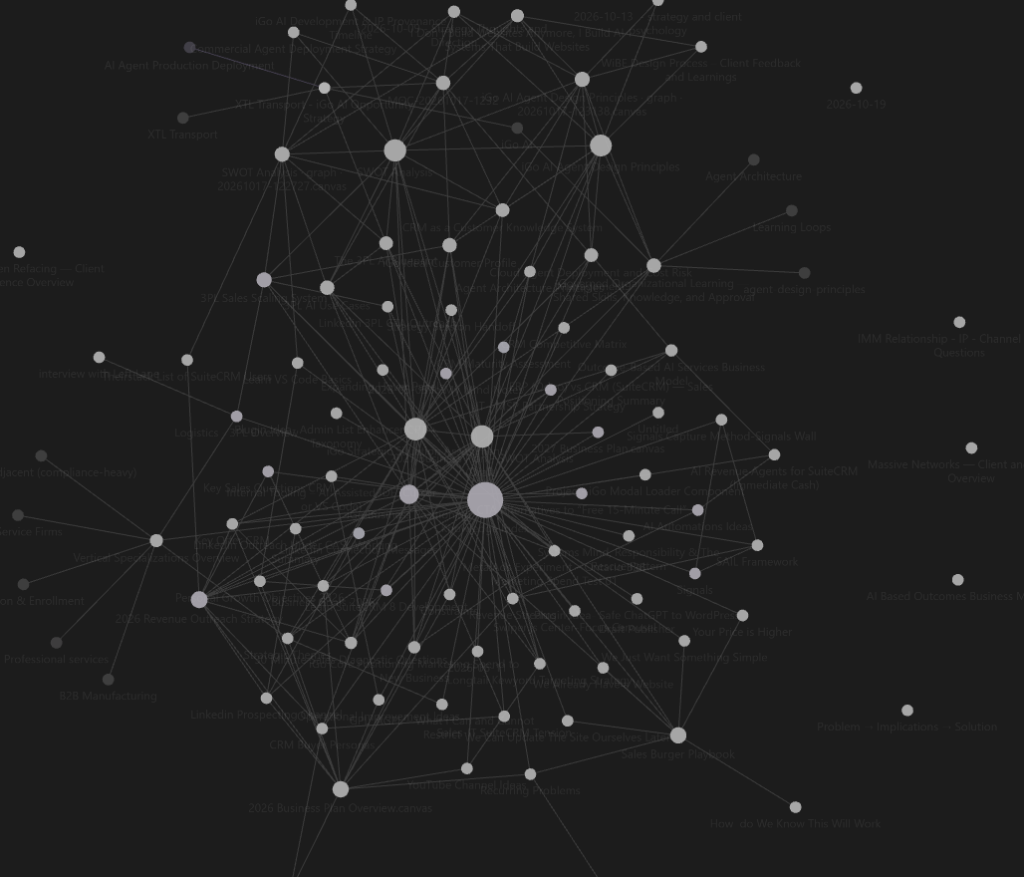
Initially, I gave it a relatively simple assignment: read the documents, understand what they’re about, and organize them.
I didn’t want it randomly rewriting my notes or reorganizing years of work. I wanted it to respect the original documents while making the information easier to find and use.
The first version examined more than 60 documents, built an index of the knowledge, and began creating links between related notes.
That was useful, but I wanted more.
Suppose I’d written about a particular business problem in five different documents over two years. Maybe I’d researched it, tried something, learned a lesson, and later revisited the subject.
I wanted the Librarian to recognize that these documents were connected and create a consolidated summary of what I’d learned.
So we added a knowledge synthesis capability.
Now the Librarian could take information scattered across multiple documents and create a coherent knowledge page, complete with references back to the original sources.
It also keeps track of which source documents have changed, allowing the knowledge summaries to be updated rather than recreated from scratch.
The result is something approaching a living knowledge base of my business.
Not just a collection of files, but an organized body of information that can evolve as I add to it.
I was pleased with the result.
But then I found myself thinking about my old boss and his swamp.
I’d built a pretty good library.
I still didn’t know where to dig the ditch.
From Librarian to Chief of Staff
The next step was to give another AI agent access to that organized knowledge.
This one would have a different job.
I called it my AI Chief of Staff.
I wanted it to look at the accumulated information about my business, consider my goals and constraints, and help me see the bigger picture.
What was working? What wasn’t? Where were the opportunities? Which activities were consuming time without producing enough value?
Most importantly, what should I concentrate on if I wanted to make meaningful progress rather than constantly reacting to whatever landed on my desk?
I asked it to produce a strategic assessment of my business.
It began by reading the knowledge accumulated in Obsidian, including previous planning documents, research, decisions, and notes about projects I’d worked on.
It produced an initial analysis of the business, identified some strengths and weaknesses, and suggested several directions worth considering.
Some of its observations were quite good.
It recognized the tension between serving existing customers and finding time to develop the business. It identified the importance of recurring revenue and the risks of relying too heavily on the business owner for everyday delivery.
It also asked questions.
That was something I particularly liked. Rather than simply presenting a grand strategy based on incomplete information, it identified areas where it needed more context.
We started working through those questions together.
I supplied financial information, talked about the demands of running the business, described opportunities I’d been considering, and explained what I’d already tried.
As the conversation progressed, the assessment became more useful.
But then something interesting happened.
My Chief of Staff Forgot Why I’d Rejected an Idea
The agent recommended a particular business development strategy.
It sounded perfectly reasonable.
In fact, if you knew my professional background and the services my company offers, you might have recommended exactly the same thing.
There was just one problem.
I’d already spent months investigating that very approach and concluded it wasn’t commercially practical.
I explained my previous research, the obstacles I’d encountered, and why I’d decided not to pursue it.
The agent acknowledged the information and revised its strategy.
Then it suggested something else that looked equally sensible on paper.
Unfortunately, this recommendation overlooked another important part of my business history.
Once again, I had to explain not only what I’d done in the past, but why I’d made certain decisions.
That’s when the real lesson emerged.
The AI could identify opportunities based on my experience, but it didn’t always understand the lessons I’d learned from that experience.
And that’s a significant difference.
An AI can generate an endless supply of plausible business strategies. In fact, that’s part of the problem. Every new idea can sound compelling when presented with enough confidence and a well-structured argument.
But a useful Chief of Staff needs more than the ability to generate ideas.
It needs to remember which ideas have already been investigated, what happened, what decisions were made, and why.
It needs to distinguish between something I haven’t tried, something I tried unsuccessfully, and something I deliberately rejected for a specific reason.
Otherwise, I’m right back where I started, continually revisiting the same ground.
So we went back to work.
This time, we weren’t just correcting the recommendation.
We were improving the system’s ability to retain strategic decisions, the evidence behind them, and the circumstances under which those decisions should be reconsidered.
The idea is that future assessments should build on what the business has already learned, rather than starting with a fresh collection of plausible suggestions every time.
And, importantly, I still want the agent to challenge me.
If new evidence suggests a decision I made years ago is no longer valid, I want to hear about it.
I just don’t want to spend another three months discovering something I already knew.
Starting to See the Bigger Picture
After several iterations, something began to change.
Instead of continually generating new ideas, the Chief of Staff started helping me organize the possibilities into a smaller number of coherent directions.
It became better at distinguishing between capabilities I possessed, opportunities that might exist, and opportunities I’d actually validated.
It also began separating the problems I needed to address immediately from the longer-term changes required to improve the business.
That distinction matters.
Like most small business owners, I can find a hundred things I could improve tomorrow.
I could build another automation, launch another marketing initiative, develop another service, or experiment with another technology.
Some of those might be excellent ideas.
But every one requires time, attention, and energy that I don’t have in unlimited supply.
The Chief of Staff’s role is to help me evaluate those choices in the context of the whole business, not simply encourage me to chase whichever idea sounds most exciting today.
And there’s another benefit I’m beginning to appreciate.
When I stop working on strategy to deal with client obligations, the thinking doesn’t have to disappear.
The research, conclusions, rejected approaches, unresolved questions, and next decisions can all be preserved.
When I return, I can continue the conversation instead of reconstructing it.
For someone constantly interrupted by client work, that’s potentially enormously valuable.
Have I Drained the Swamp?
Not even close.
The Librarian is working, and the Chief of Staff has produced its first meaningful strategic assessment. But this is still an evolving system, and I’m learning where it helps and where it needs improvement.
It hasn’t magically found me a hundred new customers.
It hasn’t eliminated my daily workload.
And it certainly hasn’t replaced my responsibility for making business decisions.
What it has done is give me a way to turn years of accumulated business knowledge into something I can actively use for planning and decision-making.
Meanwhile, I’m developing other AI agents to help with the everyday delivery work that consumes so much of my time.
My longer-term vision is to bring these ideas together.
One set of agents helps me deal with the alligators, reducing the amount of repetitive work that requires my personal attention.
The Librarian maintains the accumulated knowledge of the business.
And the Chief of Staff helps me work out where to dig the ditch.
I don’t see this as building an autonomous AI executive that runs my company while I sit on a beach.
I see it as giving a small business access to some of the organizational capabilities that larger companies take for granted: structured knowledge, institutional memory, strategic analysis, and continuity.
Of course, there still needs to be a human making the decisions.
But perhaps that human can spend a little less time trying to remember everything, reconsidering old decisions, and deciding which of a hundred possible things to do next.
I keep coming back to my old boss’s advice.
You can’t ignore the alligators. They still need to be dealt with.
But if all you ever do is fight them, you’ll be fighting them forever.
You have to keep taking those shovel-fulls of mud.
And if AI can help me figure out which ditch to dig, while freeing up a little more time to dig it, that’s a pretty good use of the technology.
