
For many 3PLs, the physical movement of freight is only part of the job.
Once a shipment is delivered, there is still an administrative chain that has to happen before the customer can be invoiced. The Proof of Delivery has to arrive, someone has to review it, identify the correct shipment, attach the document to the record, update the shipment status and move it into the invoicing process.
At enough volume, that becomes a real operational bottleneck.
This is exactly the kind of workflow where AI-assisted automation can make a meaningful difference.
Watch the video walkthrough
The Problem: Delivery Does Not Mean the Process Is Finished
From an operations perspective, a shipment may be complete when the freight reaches the consignee.
From a cash-flow perspective, it is not complete until the paperwork is in place and the invoice can be sent.
In many 3PL environments, PODs still arrive through email as PDFs, scanned documents or images. Someone then has to:
- Open the email
- Download the attachment
- Read the POD
- Identify the shipment
- Search the TMS, CRM or operating system
- Confirm that the document matches the correct load
- Attach the POD to the shipment
- Update the shipment status
- Release the shipment for invoicing
Individually, none of these steps are especially difficult.
The problem is repetition.
When dozens or hundreds of documents arrive every day, the process becomes expensive, slow and prone to delay.
I Have Seen the Business Impact First-Hand
Years ago, when I worked in 3PL operations, POD processing required essentially a full-time person.
At the time, we implemented what would now be considered a fairly crude OCR-based system. It scanned PODs and attempted to identify information such as BOL numbers and reference numbers.
A human reviewer still had to look at the image, check the OCR results and manually determine which shipment the document belonged to.
Even with those limitations, the system had a measurable financial impact.
By accelerating the flow of completed shipments into invoicing, we reduced Days Sales Outstanding and improved cash flow by approximately $200,000.
That experience left me with a simple lesson:
The value of POD automation is not just administrative efficiency. It is shortening the distance between delivery and getting paid.
What Is Different Today?
Traditional OCR was largely about recognizing characters.
Modern AI can do more.
It can interpret an unstructured document, identify relevant information and use that information in the context of the surrounding business process.
That means the system does not have to stop at:
“I found a BOL number.”
It can continue to:
“I found the likely shipment, validated the match, attached the POD and moved the shipment into the invoicing queue.”
That is a much more useful form of automation.
The Proof-of-Concept Workflow
I recently built a proof-of-concept workflow to demonstrate how this can work inside a 3PL.
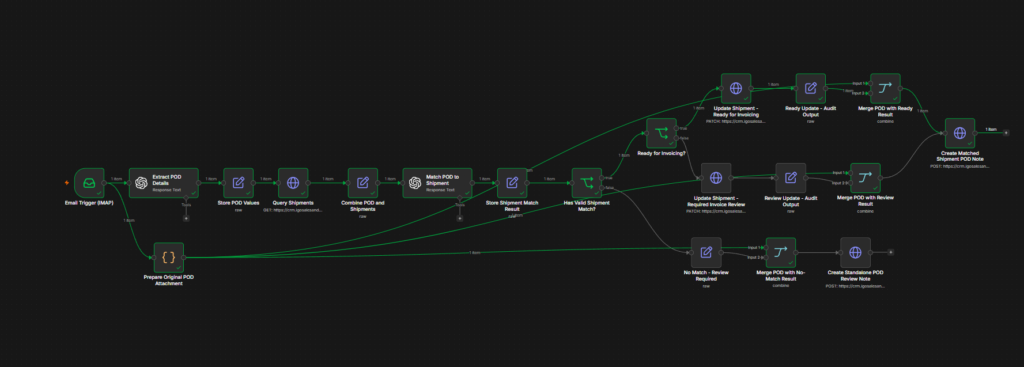
The workflow starts when a carrier sends a POD by email.
From there, the process runs automatically.
1. The POD Arrives by Email
The carrier sends the POD as an attachment.
There is no new portal to learn and no special process for the carrier to follow.
The automation works behind the existing email workflow.
2. AI Reads the Document
The attached POD is analyzed and relevant shipment information is extracted.
Depending on the document, this can include items such as:
- BOL number
- Shipment or reference number
- Carrier information
- Pickup location
- Delivery location
- Shipment dates
- Other identifying details
3. The System Searches for the Matching Shipment
Reading the document is only half of the problem.
The more important task is identifying which shipment it belongs to.
The workflow uses the extracted information to compare the POD against shipment records already stored in the operating system.
Instead of relying on one single field, the matching process can use multiple data points to determine the most likely shipment.
4. The POD Is Attached to the Shipment
Once the shipment has been identified, the POD is automatically attached to the corresponding shipment record.
No one has to download and re-upload the file.
5. The Shipment Is Updated
The workflow then updates the shipment so it can move to the next step in the process.
In this proof of concept, the shipment is marked:
Ready for Invoicing
At that point, the document is in place and the shipment is ready for the billing process to continue.
The Real Benefit Is Straight-Through Processing
The goal should not necessarily be to eliminate every human touch.
Real logistics operations are full of exceptions.
A POD may be incomplete.
The document may be illegible.
Two shipments may look nearly identical.
The wrong document may have been sent.
Important information may be missing.
A good automation strategy does not pretend those situations do not exist.
Instead, it allows the obvious transactions to move through automatically and sends only the uncertain ones to a person for review.
Automate the routine. Escalate the exception.
That is a much more practical way to use AI in logistics.
Benefits for a 3PL
An AI-assisted POD workflow can create value in several areas.
Faster Invoicing
The sooner a POD is received and matched, the sooner the shipment can be invoiced.
Reducing administrative delay can have a direct impact on cash flow.
Reduced Administrative Work
Employees no longer need to spend as much time opening attachments, searching for shipments, attaching documents and updating records.
Lower Days Sales Outstanding
If completed loads consistently reach billing faster, invoices can go out sooner.
That can improve the speed at which revenue is converted into cash.
Increased Capacity Without Matching Headcount Growth
If shipment volume increases by 20% or 30%, administrative staffing does not necessarily need to increase at the same rate.
Automation allows the same team to process more freight.
Better Document Control
PODs are attached directly to the correct shipment rather than remaining scattered across email inboxes or shared folders.
More Consistent Processes
Automation follows the same workflow every time.
That helps reduce variation between employees and shifts.
Faster Exception Identification
Documents that cannot be confidently matched can be flagged immediately rather than sitting unnoticed in an inbox.
This Is Not Really About POD Scanning
POD processing is simply a good example of a much larger opportunity.
Most 3PLs have dozens of workflows that sit between:
- Documents
- People
- TMS platforms
- CRM systems
- Accounting systems
- Carrier portals
- Customer portals
Historically, people have acted as the connection between all of those systems.
They read the email.
They interpret the document.
They search the software.
They enter the information.
They decide what happens next.
AI and workflow automation now make it possible to automate much more of that connective work.
Other 3PL Workflows That Can Be Automated
The same approach can be applied to processes such as:
- Inbound order entry
- Shipment status updates
- Tracking and tracing
- Invoice and document matching
- Carrier document processing
- Customer status notifications
- Rate confirmation processing
- Claims intake
- Exception management
- Accounts receivable workflows
The technology is important, but the best starting point is usually not:
“Where can we use AI?”
A better question is:
“Where are people repeatedly moving information between emails, documents and systems?”
Those are often the best automation opportunities.
Start With the Workflow
At iGo AI, the approach is workflow-first.
The objective is not to introduce AI simply because it is available.
The objective is to identify repetitive, expensive or slow processes and determine where AI and automation can create measurable operational value.
Sometimes that means a simple workflow.
Sometimes it means integrating multiple systems.
Sometimes it means keeping a human approval step in the middle.
The right solution depends on the process.
If you operate a 3PL and have a workflow that still relies heavily on email, documents and manual data entry, there is a good chance it is worth examining.
Learn more about AI automation for logistics and 3PL operations at iGo 3PL AI Solutions.
For SuiteCRM customization, consulting, integrations and implementation, visit igosalesandmarketing.com.
